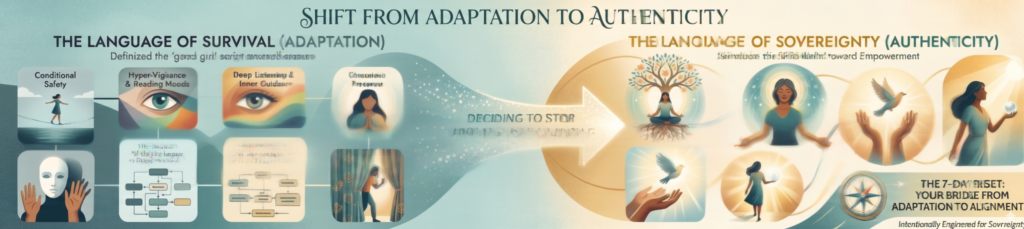
Discover how childhood conditioning builds the architecture of self-abandonment, and learn the somatic framework to reclaim your authentic sovereignty.
We do not simply wake up one morning and consciously choose to abandon ourselves. The departure from our own center happens gradually, evolving in the quiet spaces of our early lives. Like learning a second language we never intended to study. When everyone around you speaks it fluently, adaptation becomes your only tool for survival.
To say that self-betrayal became my second language is to recognize a conditioning that began in childhood. Very early on, many of us absorb the unspoken rule that choosing our own desires could cost us the emotional safety of love. Stepping into the fullness of our emotional self does not invite comfort or validation; instead, it is met with distance, frustration, or subtle punishment.
This is how the early signs of self-abandonment begin to take root.
True betrayal rarely begins with grand, dramatic declarations. It cements itself in the architecture of the mind through tiny, imperceptible concessions:
- “I don’t like this… but it’s okay.”
- “I’m uncomfortable… but I’ll stay.”
As children, we are entirely at the mercy of the adult world that shapes our reality. When the adults entrusted with our care are unconsciously abandoning themselves, their sacrifice becomes our blueprint for normal.
I watched my mother navigate her own quiet concessions, offering up pieces of her identity for her children and the survival of our family. Without realizing it, I inherited her conditioning. I learned to speak the exact language she had been forced to master. This is a classic example of how we unconsciously inherit generational trauma.
There is a profound difference between a healthy relationship and the mechanics of self-erasure. Real compromise occurs when two people bring their respective truths to the table to create something shared.
Betrayal is an entirely different transaction. It is the moment you hand over your truth completely, voluntarily carrying the emotional weight so that someone else doesn’t have to face theirs.
This is where the pattern took root. This is how the language became my own. Yet, the vocabulary of survival is never confined to our thoughts alone; eventually, it demands a physical space to reside.
The Somatic Architecture: Where the Silence Began
To understand how we learn to override our own boundaries, we must look at where the somatic response to trauma first takes hold. For me, the architecture of silence was built in a bustling living room. It was buried beneath the mundane sounds of daily family life.
My mother’s boyfriend had woven himself into our household. I remember the layout of our world back then. My brother is playing, the house helper is cooking, and my mother is deeply focused on her studies. She was working toward her physical therapy license, while I ran in and out of these little pockets of safety.
Then came the shift. He would call me over under the guise of needing comfort—asking for a kiss to “feel better”—and pull me onto his lap.
Even before my mind could fully articulate the danger, my body knew. I would place my hands firmly on my own legs. A small child’s instinctive attempt to build a fortress for herself. My entire physical system would go quiet—limbs heavy, shoulders dropped, face completely blank. This is the classic freeze response. A state of helpless immobility where the body attempts to protect the spirit by numbing the senses.
The boundary violation was subtle enough to masquerade as affection, yet entirely too intimate for a child. It was an intentional, adult energy disguised as a family joke. In the aftermath, a heavy blanket of misplaced shame and cleanliness issues settled over me. Yet, I chose not to speak. A part of me was terrified that the truth would be turned against me—that I would be blamed for seeking the very attention I naturally craved.
Years later, through the lens of Human Design, I discovered I am a Projector. Inherently, being deeply seen and recognized is what fills my spirit. But as a child, that beautiful, innate need was weaponized by circumstance. On that lap, an unconscious survival strategy was born. If I can endure this, if I can keep the adults happy, then perhaps we will all be safe. Perhaps my mother will finally receive the love she needs, so she can have enough left over to love me.
That was the day my body memorized the rules of self-erasure. And once the body learns how to swallow its own discomfort to preserve the peace. It prepares the child for an exhausting, lifelong role.
The Blueprint of the Parentified Daughter
That single, isolated pattern quickly expanded into a total blueprint for how I related to the entire world. The operating system became clear: “If they are okay, I am safe. If I am uncomfortable, I can simply absorb it.” This is the precise definition of a parentified daughter. A child who is forced to prematurely step into the role of the emotional adult. Then managing the psychological climate of the household.
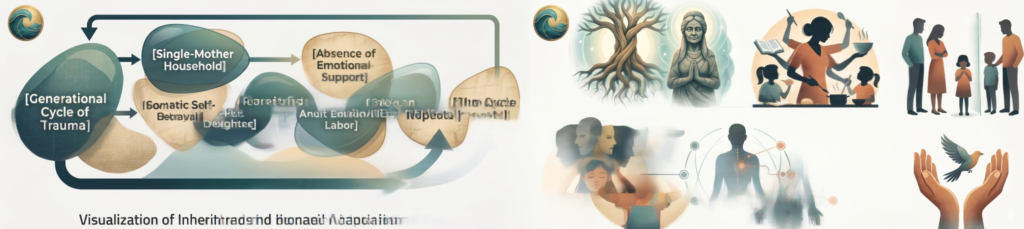
Infographic visualization of ‘The Blueprint of the Parentified Daughter.’
In emotionally immature or high-stress environments—particularly in single-mother homes like mine. This weight almost automatically lands on the shoulders of the eldest girl. In my own family history, at least four generations of women had navigated the challenges of raising children alone.
The ancestral groove was incredibly deep: when the matriarchal system is under immense pressure, someone has to step up to hold the structure together. In our lineage, that responsibility became the birthright of the oldest daughter.
For me, navigating the signs of a parentified daughter meant hyper-vigilantly managing my mother’s emotional ecosystem so our family didn’t have to walk on eggshells. I became an expert at reading her mood before she ever spoke a word.
I learned to soothe, to joke, and to fix. Deploying whatever emotional labor was required to keep her world from fracturing.
Inevitably, this responsibility expanded outward. I stepped into the role of a secondary parent for my younger brother, learning to manage his behavioral outbursts and quietly covering for his mistakes to maintain a fragile domestic peace.
When our family immigrated to the United States, these complex immigrant family dynamics intensified the pressure significantly. Our entire extended support system remained behind in Colombia.
We were navigating a completely new society with no extra hands and no financial cushion. Because I was the one who acquired English first. I was thrust into the role of “language brokering”. Now acting as the literal translator between my mother and teachers, doctors, and school administrators. At a tender age, I became the primary communication bridge between my family and the outside world.
During those years, I proudly called myself “the glue.” I believed it was my sole responsibility to hold our fractured world together. To protect my mother from any additional stress, I constructed a flawless exterior: perfect grades, zero conflict, and completely invisible personal needs.
The unwritten, internal job description I carried every day was simple: I must ensure everyone else is stable. I must hold the weight of this world. I am not allowed to be a burden.
This is the exact psychological soil where the roots of deep self-abandonment thrive. When survival depends on perfection and self-erasure, the code naturally begins to dictate how we treat the most sacred boundary of all: our own bodies.
Somatic Echoes: How Self-Abandonment Settles into the Body
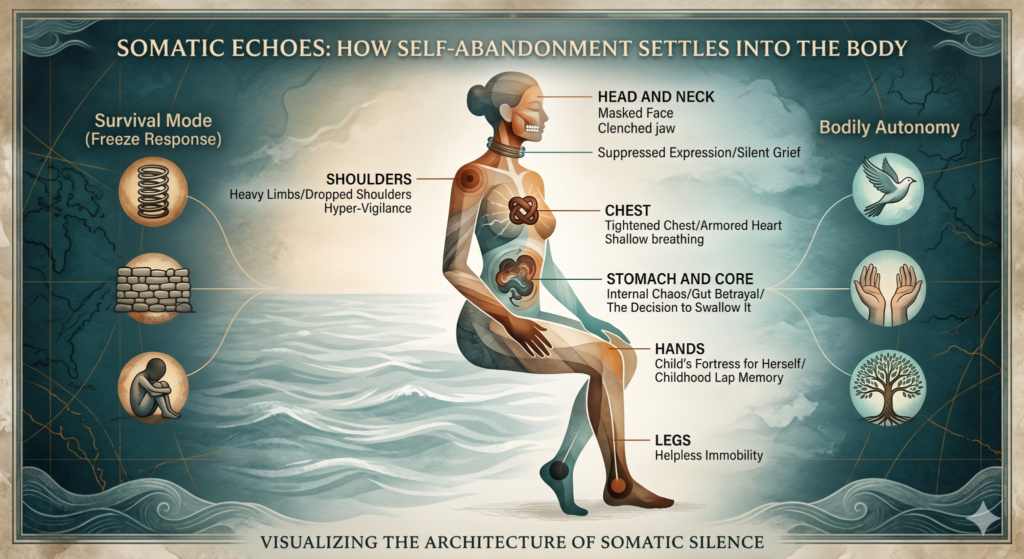
Infographic visualization: Somatic Echoes: How Self-Abandonment Settles into the Body
Once an internal code of self-erasure is established, it inevitably manifests across every area of our lives. For many women, the most profound somatic symptoms of trauma and conditioning show up in our relationship with our own physical bodies—governing what we wear, how we move, and how much of ourselves we allow to be seen by the world.
Growing up within the confines of a rigid religious environment, I quickly learned the unspoken rules of religious purity culture. There was a constant, heavy surveillance regarding what was considered modest versus what was deemed “too much.” I vividly remember a day when the pastor’s son openly criticized my choice of clothing, making his disapproval clear. Outwardly, I snapped back with sharp defiance: “Good thing you don’t buy my clothes. I do. And so does my mom.”
On the surface, that moment looked like an act of pure confidence. Inside, however, the young girl was deeply shaken.
To cope with that boundary violation, I began wearing more revealing clothing—not out of a genuine, grounded desire to express my authentic self, but as a form of survival-driven rebellion. I wasn’t choosing my wardrobe from a place of personal joy; I was choosing it from a place of defiance.
This is a subtle, yet pervasive form of self-abandonment: changing who we are to react against someone else’s rules is still a way of letting them dictate our identity. It was simply self-betrayal wrapped in a louder outfit.
Inevitably, this fractured connection with my body extended into my early experiences with intimacy and sexuality.
The societal and peer pressure surrounding the milestone of losing one’s virginity was immense. Driven by a deep, human need for belonging and acceptance among my peers, the moment became more of a social transaction than a sacred, grounded choice. I remember the lack of romance, the absence of tenderness, and the overwhelming feeling of just wanting to “get it over with” to fit in. It was a profound disconnect—an experience I would never wish for my own daughter to endure.
In that quiet room, I overrode my body’s natural timing and boundaries just to hold a passport to belonging, all while keeping the truth hidden from my mother. By treating my body as a currency to buy acceptance, the language of self-erasure had officially moved in and made itself at home.
And when we learn to treat our physical selves as a transaction for belonging, it sets a dangerous precedent for the types of romantic partnerships we subconsciously invite into our lives.
Mirroring the Script: Trauma Bonding and Toxic Relationship Cycles
When self-abandonment becomes your primary mode of operating, it alters your interpersonal radar. You unconsciously begin attracting and settling for partnerships that speak that exact same language of conditional worth. This is how the subtle cycles of trauma bonding in relationships begin to replicate the unhealed wounds of childhood.
My early dating life perfectly mirrored this internal script. First came the classic Colombian “good boy”—a talented soccer player with excellent grades and a flawless public mask. On paper, he was the ideal partner. In reality, he was trapped in the exact same “golden-child” performance that I was navigating.
When our relationship eventually dissolved after two years because he sought out someone else, he attempted to draw me into a public, competitive conflict with the other woman.
That moment marked one of my earliest, quiet victories of non-betrayal. I flatly refused. I chose not to compromise my basic dignity by fighting another woman over a fractured relationship.
However, because the deeper root of my self-worth had not yet been healed, the pendulum swung to the opposite extreme. I moved from the overachievers to the classic “bad boys.” One relationship in particular rapidly deteriorated into an environment of chaos and physical violence, eventually requiring me to seek a formal restraining order for my own safety.
Yet, the psychological pull of familiarity is incredibly powerful.
Even after the safety boundary was drawn, I found myself slipping back into that space for a time, mistaking the comfort of a familiar prison for actual safety. This is a primary sign of a toxic relationship: staying long after love has completely left the room because your nervous system is addicted to the stress cycle.
Perhaps the most insidious distortion of trust came from a youth leader in my community—someone whose spiritual authority made him appear safe. What began as a trusted connection evolved into a summer relationship, which ultimately ended in an act of severe betrayal: he recorded our private intimacy without my full realization and kept the footage as emotional leverage.
For over a decade, the deepest injury wasn’t just his violation of my trust; it was the psychological prison I built around myself in the aftermath. I responded by shrinking. I allowed that hidden leverage to dictate my value, carrying a silent shame that contaminated every relationship that followed.
Each new partnership became a subconscious courtroom where I attempted to prove a painful, unhealed belief: This is what I deserve. This is the only version of love available to a woman with my history. When we are locked in this cycle, we continually accept treatment that matches our hidden fractures rather than our true worth.
Yet, the final and most sophisticated survival strategy of the good girl is not rebellion—it is wrapping our survival in the flawless, unassailable mask of spiritual duty.
Holy Masks: Sanctified Duty and the Illusion of Safety
Eventually, the pattern of self-abandonment becomes so sophisticated that it learns to wear a holy mask. I reframed my past survival, telling myself and my community that I was “the girl who survived the video,” transforming my raw trauma into an acceptable religious testimony.
But beneath the spiritual vocabulary, the core programming remained unchanged: I was still just the “good girl” trying to perform well enough to finally earn a baseline of emotional safety.
It was during this period that I met the man who would become my husband. He was privy to my history; he knew the wild, unpolished chapters of my journey, and he offered a level of acceptance that exceeded anything I had experienced up to that point. Our connection was genuine, deep, and soulful.
Yet, when the choice of marriage arrived, the unhealed architecture of fear became deafening.
It was a chaotic symphony of religious conditioning and deep-seated insecurity: fear of living “in sin” according to rigid scriptural doctrines, fear that my past rendered me fundamentally unchoosable, and the terrifying belief that no one else would ever accept a woman with my specific history.
Driven by these underlying currents, I stepped into marriage—not solely from a place of liberated love, but out of a sense of institutional duty, doctrinal obligation, and the ultimate desire to fulfill the “good girl” script.
Once inside the marriage, the language of self-erasure simply assumed a more socially acceptable shape.
To maintain the illusion of the perfect partnership, I began hiding significant pieces of my reality.
I concealed my holistic relationship with cannabis, tucked away my true emotional needs, marginalized certain friendships, and edited my authentic self out of the daily narrative. I voluntarily shrank to fit into a traditional blueprint of what a wife “should” be.
This expectation wasn’t malicious or random; it was a set of inherited behaviors he carried from his own family systems. We were two well-intentioned people operating out of unexamined, generational blueprints. From the outside, our life appeared completely blessed.
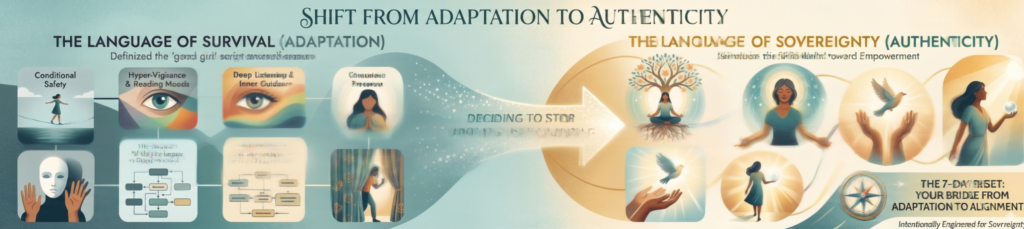
Infographic visualization: Reclaiming the Self: Breaking the Language of Fluency
That is the insidiously beautiful trap of self-abandonment. It becomes a fluent, seamless language long before anyone else—including yourself—even notices you are speaking it. The challenge on the path to healing is never the learning process; you have already mastered the vocabulary of survival through decades of practice.
The true turning point lies in the quiet, visceral decision to stop. It requires a commitment that registers deeply within your physical body, not just your intellectual mind, to declare that you are finally ready to dismantle the architecture of silence.
Learning how to stop self-betrayal is not about assigning blame to the past; it is about stepping into the profound authority of your present.
It is the brave work of recognizing where the old codes are still running your life, gently untangling your worth from your performance, and choosing to finally arrive for yourself.
If the weight of these words has resonated within your body, it is a sign that your system is ready to shift from survival to true sovereignty. The 7-Day Reset was intentionally engineered for exactly this moment—a guided, compassionate bridge designed to help you drop the language of adaptation and speak your truth aloud.